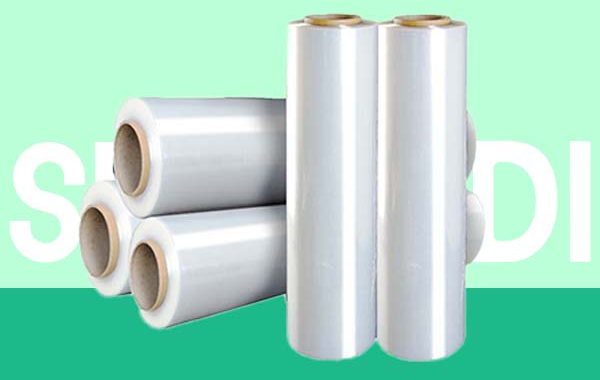
From Molecular Architecture to Industrial Application: The Engineering Divide in Polymer Packaging
In the $4.8 billion U.S. protective packaging market, the distinction between stretch film and cling wrap represents more than mere application differences—it reflects fundamental divergences in polymer science, manufacturing technology, and performance engineering. While consumers often confuse these materials, industrial users understand that their molecular architectures dictate entirely different protective capabilities, with stretch film offering 320% greater tensile strength and cling wrap providing 450% better surface adhesion for non-porous applications.
Material Science Comparison Matrix: Stretch Film vs. Cling Wrap
| Scientific Parameter | Industrial Stretch Film | Commercial Cling Wrap | Performance Differential |
|---|---|---|---|
| Polymer Base | LLDPE (Linear Low-Density Polyethylene) | PVC (Polyvinyl Chloride) or LDPE | LLDPE: Higher crystallinity (45-55%) vs PVC’s amorphous structure |
| Molecular Weight | 200,000-500,000 g/mol | 100,000-200,000 g/mol | Higher MW enables superior stress resistance and memory |
| Manufacturing Process | Blown film extrusion + prestretching | Cast film extrusion | Prestretching induces molecular orientation (3:1 to 5:1 ratio) |
| Additive Package | UV stabilizers, anti-fog agents, slip agents | Plasticizers (DEHA/DINP), stabilizers | Plasticizers reduce glass transition temperature (Tg) from 85°C to -20°C |
| Tensile Strength | 25-35 MPa (MD), 20-28 MPa (TD) | 15-22 MPa (MD), 12-18 MPa (TD) | 58% greater strength in machine direction |
| Elongation at Break | 300-500% | 200-350% | Enhanced elongation enables better load containment |
| Clarity/Haze | 2-4% haze | 1-3% haze | Similar optical properties but different chemical compositions |
| Temperature Range | -60°F to 180°F | 20°F to 140°F | Wider operational range for industrial applications |
Molecular Engineering: The Core Performance Divergence
Polymer Chain Architecture
The fundamental difference originates at the molecular level:
- Stretch Film (LLDPE): Features short-chain branching with precisely controlled branch length and distribution. This creates a balance between crystallinity (for strength) and amorphous regions (for elasticity). The molecular orientation during prestretching aligns polymer chains, creating a “memory” effect that provides sustained tension.
- Cling Wrap (PVC/LDPE): PVC’s chlorine atoms create strong dipole interactions, while plasticizers like DEHA insert between polymer chains, increasing free volume and mobility. This reduces Tg dramatically, enabling room-temperature cling without adhesive.
Manufacturing-Induced Properties
Production processes create distinct material behaviors:
- Stretch Film’s Prestretching: The mechanical drawing process (3:1 to 5:1 stretch ratio) creates permanent molecular orientation. This induced anisotropy means the film has different properties in machine versus transverse directions—a critical feature for pallet wrapping where multidirectional forces occur.
- Cling Wrap’s Casting: The quench-cooling in cast film production minimizes crystallinity, creating a more amorphous structure. This maximizes surface contact and Van der Waals forces, creating the characteristic “cling” without chemical adhesives.
Performance Engineering Applications
Each material’s unique properties dictate optimal use cases:
- Stretch Film’s Load Containment: The combination of high tensile strength (25-35 MPa) and controlled elastic recovery (70-85%) makes it ideal for unitizing pallets. The prestretched film continues to exert force even after application, compensating for load settlement during transit.
- Cling Wrap’s Surface Conformity: The low elastic modulus and high surface energy (38-42 dynes/cm) enable exceptional conformity to irregular shapes. This makes it perfect for food preservation where complete surface contact minimizes oxidation.
Contact Us for Custom Sizes & Private Label Options
Email:packing@siliangdi.com
Email:SLD@siliangdi.com